
Omni Channel Inventory Optimization
Streamlining global retail and warehouse operations through automated demand planning, inventory rebalancing, and real-time sales intelligence.
1. Problem Statement – Detailed Understanding
Business Context:
- Operations:
- Australia: 1 main warehouse + 3 offline retail stores (which also act as mini-warehouses).
- USA: 1 warehouse for fulfilling only US orders.
- Australia: 1 main warehouse + 3 offline retail stores (which also act as mini-warehouses).
- Sales Channels: Primarily in Australia, some in the USA, through Shopify website and Retail stores.
- Target Days of Cover: 90 days (ensure stock lasts at least 60 days post-procurement).
- Current State: Inventory planning done in Google Sheets.
Challenges Identified:
- Inefficient Inventory Allocation at Stores
- Slow-moving stock remains stuck in certain locations, while the same SKUs sell out elsewhere.
- Causes missed sales in some areas and overstocking costs in others.
- No early warning system for
- Low stock on top sellers at the Store
- Stock with decreasing ROS (Sales velocity)
- Slow moving stock at a Store
- Data Inaccuracies & Delays
- Manual spreadsheet dependency → high risk of human error.
- Slow data updates → missed opportunities to adjust procurement or replenishment in time.
- Manual spreadsheet dependency → high risk of human error.
2. Solution – Detailed Breakdown of Implementation
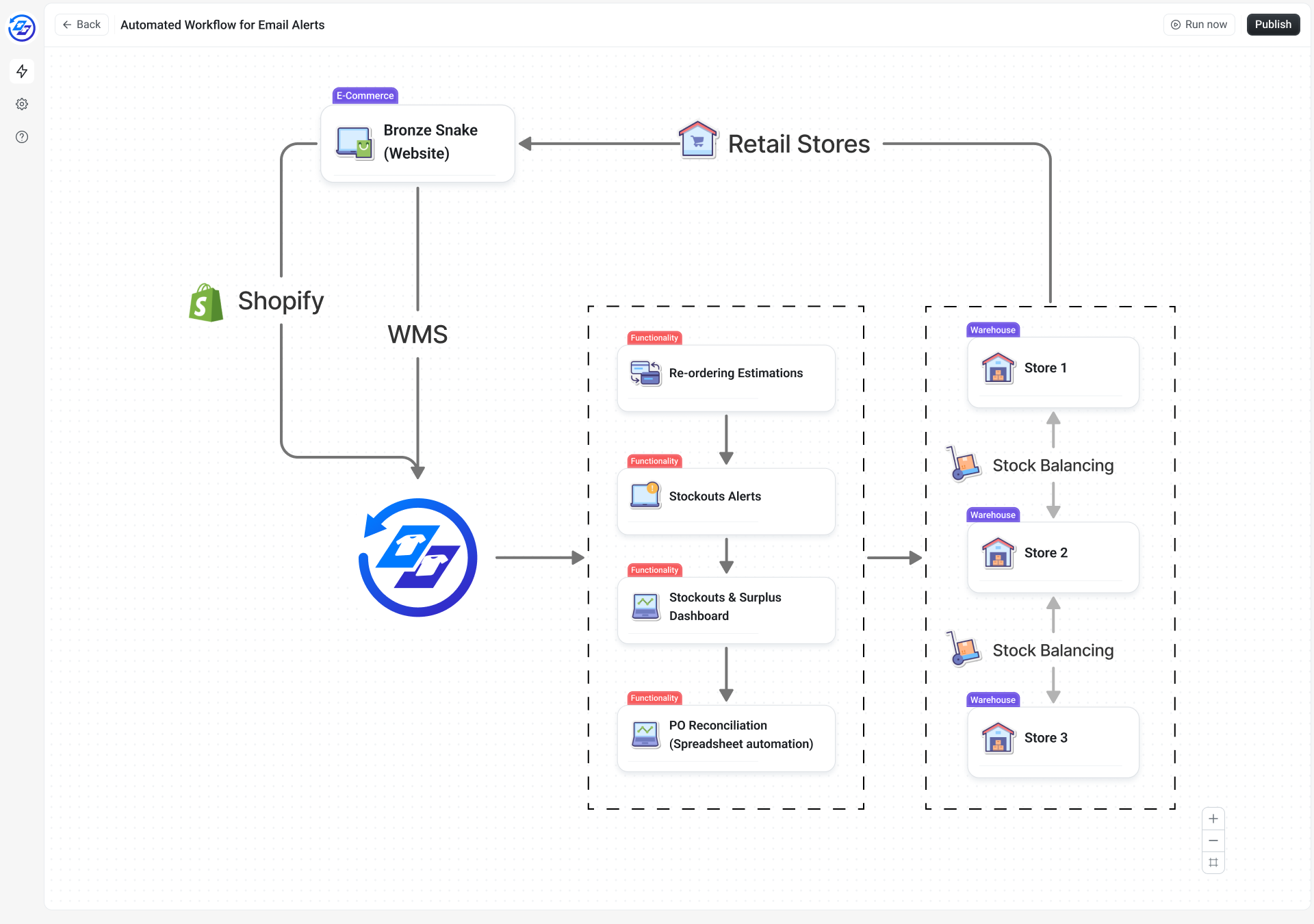
A. Demand & PO Planning:
- Centralized Demand Aggregation and Reorder Estimations
- Combine sales data from Australia WH + 3 retail stores.
- Use this combined demand to auto-generate accurate POs for the Chinese vendor.
- Removes manual spreadsheet guesswork.
- Combine sales data from Australia WH + 3 retail stores.
- Separate PO Planning for US WH
- US warehouse has its own sales trends & stock needs.
- Plan POs specifically for US orders, without interfering with AU stock.
- US warehouse has its own sales trends & stock needs.
B. Inventory Rebalancing:
- Excess Stock Recommendations
- Identify slow-moving items in stores.
- Recommend sending them back to the Australia WH.
- Redistribute from Australia WH to other stores where demand is high.
- Identify slow-moving items in stores.
- Automated Store-Level Replenishment
- Live sales velocity from each store → triggers replenishment from AU WH.
- Avoids manual allocation delays.
- Live sales velocity from each store → triggers replenishment from AU WH.
C. Forecasting Accuracy:
- Out-of-Stock Adjusted DRR (Demand Run Rate)
- Adjust demand calculations to ignore periods when an SKU was out of stock.
- Prevents underestimation of demand for fast-sellers.
- Adjust demand calculations to ignore periods when an SKU was out of stock.
E. Alerts & Reporting:
- Daily Email Reports
- Sales trends by SKU, style, and category.
- Highlight top-performing products to capitalize quickly.
- Sales trends by SKU, style, and category.
- Alert System
- Delayed POs → email & dashboard notification.
- Low coverage items → triggers replenishment.
- Slow movers → flagged for clearance or reallocation.
- Delayed POs → email & dashboard notification.
